Facade painting —
elastic, breathable & durable
domain Facade painting

Facade painting
with liquid rubber — breathable & crack-bridging

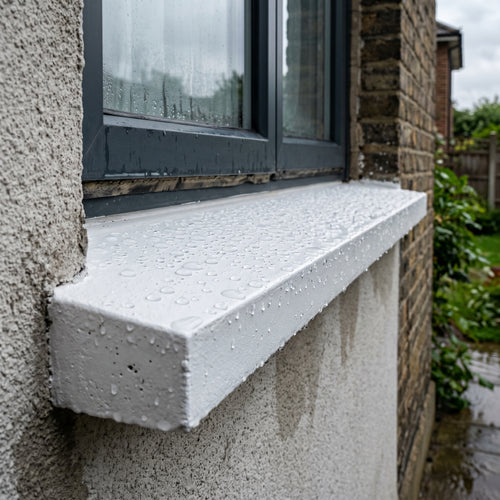
Elastomeric facade paint against cracks, weathering and algae infestation. Direct on render, concrete or masonry — without primer in most cases. Follows thermal building movement and lets wall moisture escape.

summarize At a glance

Liquid rubber for facades is an elastic, water-based coating that bridges hairline cracks while remaining breathable (V2 to EN 1062-1). Apply by brush, roller or airless spray in 2 coats (100–200 g/m² each). Suitable for render, concrete, brick and plinths. Resistant to UV, frost and driving rain.

01 / The problem

Why classic facade paint fails

A facade works constantly — it heats up, cools down, gets wet, dries out. Rigid paints crack, peel, fade. The result: saturated walls, mould from the inside, and an appearance that gets worse year by year.

broken_image

Cracks from temperature swings

Facades expand in summer and contract in winter. Traditional masonry paints crack — and those hairline cracks become entry points for water and frost.

biotech

Algae, mould, soiling

Damp weather-exposed sides become a breeding ground for algae and fungi. Black spots, green film — bad for looks and building fabric, a health concern if growth reaches indoor spaces.

wb_sunny

Fading & chalking

UV radiation breaks down pigments. After 3–5 years, traditional paints look dull, fade to grey or form a chalky surface that rubs off on contact.

02 / Why RubberPaint

Why liquid rubber for facades

gesture

Bridges cracks up to 1.5 mm

Highly elastic and crack-bridging — moves with every thermal expansion of the facade. Fine hairline cracks disappear beneath the elastic membrane.

air

Vapour-permeable (V2 EN 1062-1)

Lets moisture in the wall escape outwards, but blocks rain from getting in. No moisture trapped inside the wall.

wb_sunny

UV-stable, no greying

Stabilised pigments keep their colour even after 10 years of full sun. No chalking, no fading.

hub

Works on virtually any substrate

Render, concrete, masonry, brick, older paint — paint straight over them. In most cases you can skip the primer entirely.

03 / Application

Step-by-step guide

Step 01 / 05

Prepare the substrate

A clean base for years of adhesion.

Clean the facade thoroughly — a pressure washer (min. 100 bar) removes algae, dirt, loose paint and chalking. Mechanically remove loose, flaking old paint (scraper, wire brush). Pre-fill cracks > 1 mm with repair mortar and let cure for 7 days.

For algae or fungal infestation, pre-treat with an algae/fungus remover, let act for 24 h, rinse thoroughly and let dry for 48 h.

Pro tip: The Sellotape test checks old-paint adhesion — stick a strip on and pull off sharply. If paint stays attached, the substrate is sound; if only flakes come off, full removal is needed.

Prepare the substrate
Step 02 / 05

Prime (if needed)

Lock down strongly absorbent substrates.

On strongly absorbent substrate (fresh render, lime sandstone, old lime render) or heavily chalking old paints: apply a hydrophobising deep primer. Reduces first-coat consumption by up to 30 % and significantly improves adhesion. Let dry for 12 h before further work.

On sound, closed paint, primer can be skipped — proceed directly to Step 3.

Pro tip: Apply deep primer thinly — a thick coat forms a glossy film that worsens main-coat adhesion.

Prime (if needed)
Step 03 / 05

First coat — penetration

Dilute with up to 5 % water (up to 10 % with airless sprayer).

Apply with lambswool roller (short nap, 10 mm), brush or airless sprayer (15–18 MPa, nozzle 0.021–0.026″). Dilute with up to 5 % water (sprayer up to 10 %). Diluted, the first coat penetrates the substrate and forms the bonding base. Consumption 100–200 g/m².

Particularly careful at connections to windows, doors and plinths — these detail points demand gapless coverage.

Pro tip: On tall facades use a cherry picker or scaffolding — never ladders above 4 m; the risk is too high and work quality suffers from a wobbly position.

First coat — penetration
Step 04 / 05

Wait the drying time

At least 4 hours at 23 °C.

At 23 °C and 50 % RH dry for at least 4 hours. Wait longer in cooler weather or high humidity (up to 8 h). Test: the coat must no longer be tacky to finger pressure and leave no impressions.

Protect the facade from direct sun (streaking) and rain (softening) during drying — stretch a tarpaulin if uncertain.

Pro tip: Follow the sun — start on the west side in the morning, work to the east side in the afternoon. This avoids direct sun during drying.

Wait the drying time
Step 05 / 05

Second coat — coverage

Apply undiluted, cross to the first coat.

Apply the second coat cross to the first for even coverage. Consumption again 100–200 g/m². Undiluted for full layer thickness. Rain-resistant after 6 h (manufacturer specification), fully load-bearing after 28 days.

On the weather side (south/west) a third coat is recommended — UV and rain load there is 2–3× higher than on protected sides and otherwise shortens service life.

Pro tip: Judge the final colour only after full curing (28 days) — fresh coating looks slightly milky, especially on the shaded side, but clears up completely.

Second coat — coverage
lightbulb
Pro tip

On the weather side (south/west) apply an additional third coat — UV and rain load is 2–3× higher there than on protected sides. On heavily weathered or chalky old coatings apply a deep primer first.

04 / Specifications

Technical data

Consumption per coat 100–200 g/m² (0.1–0.2 kg/m²)
Recommended coats 2 (3 for weather-exposed side)
Drying time 2 h dust-dry · 4 h recoatable
Rain resistance after 6 h (manufacturer specification)
Full cure 28 days
Application temperature +10 °C to +30 °C
Service temperature −20 °C to +50 °C
Elasticity highly elastic (Class A0/C0 to EN 1062-1)
Water-vapour permeability V2 to EN 1062-1 (vapour-permeable)
Binder Acrylic latex (solvent-free)
Tool cleaning Water, immediately after application
Material calculator

How much material do I need?

Enter your area and desired number of coats — we recommend the optimum tub combination.

Standard: 2 coats. 3 for heavily exposed surfaces.

info

Consumption: 150 g/m² per coat. +10 % buffer for offcuts and uneven surfaces. For larger projects (> 80 m²) contact us for individual advice.

Recommendation

6,6 kg needed

Calculating…

Total quantity
Total price

Free shipping from £170 — review your basket after adding.

Exterior Wall Paint — Breathable & Crack-Bridging

Cracks in the render, flaking old paint, algae growth. An elastic facade paint based on acrylic latex bridges fine cracks and stays breathable — ideal for renovations and repaints.

Why rigid paints fail

  • Mineral and silicate paints are rigid — cracks appear as soon as the render moves
  • Emulsion paint is not breathable enough — moisture builds up inside the wall
  • Bitumen-based paints turn yellow and are not UV-stable
  • Conventional masonry paint lasts 5–7 years in good conditions — our coating is rated for at least 7

Highly elastic facade paint

An acrylic-latex base makes the paint elastic (bridges cracks up to approx. 0.5 mm), breathable (water vapour permeability 60–70 g/m²·day, class V2 to EN 1062-1) and water-repellent at the same time. Bonus: 14 RAL colours available straight away, no tinting machine needed.

Step by step

  1. Check the substrate. Inspect the facade for loose areas, old coatings, algae and efflorescence. Test chalking paint with a wet cloth — does colour come off when you wipe?
  2. Clean. Pressure washer on a gentle jet (not too close), plus algae remover where needed. Allow 48 hours to dry completely.
  3. Repair cracks and loose areas. Fill cracks of 1 mm or more with an elastic repair compound. Chip out loose render and re-render it, then wait 28 days.
  4. Penetrating primer on absorbent substrates. Mineral render, concrete and fresh render are very absorbent. Prime before the first coat — otherwise consumption rises by 50 %.
  5. Two coats of liquid rubber / liquid rubber paint. Apply with a lambswool roller or airless sprayer. First coat thinned by 0–5 %, second undiluted. Consumption 150–200 g/m² per coat.
Pro tip. Paint the sunny side early in the morning (before 10 am) or late in the afternoon (after 4 pm). Direct sun makes the paint dry too fast and causes cracks from uneven film formation. On overcast days you can paint all day.

How much do you need?

For 2 coats: 0.3–0.4 kg/m². For an 80 m² facade ≈ 24–32 kg (4 × 6 kg). On very absorbent substrates, add 20 %.

Which colour?

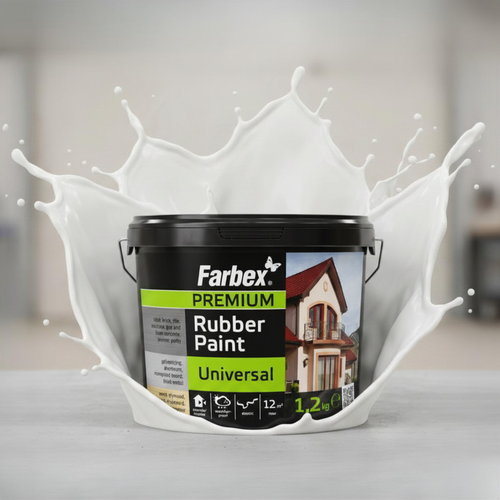
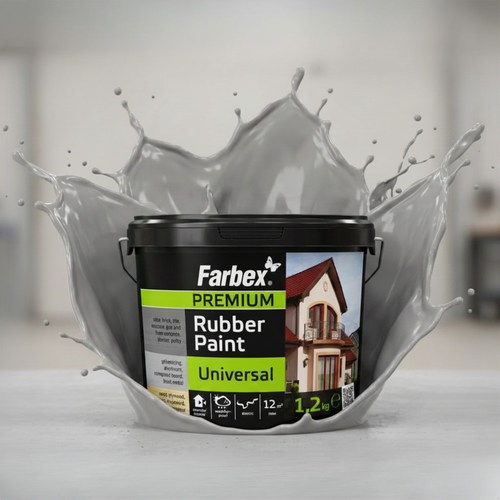
White (RAL 9003) for a classic light facade, Grey (RAL 7046) for a modern town house, Graphite (RAL 7024) for accents. All 14 RAL colours are UV-stable.

👉 See all 14 RAL colours

Common mistakes to avoid

  • Painting in the rain or on a damp wall — no adhesion
  • Absorbent substrate without primer — consumption explodes
  • Painting over algae without algae remover — they keep growing under the paint
  • Applying with frost expected within 24 h — the coating becomes brittle

FAQ

Which substrates are suitable?

Mineral render, lime-cement render, concrete, brick and sound old emulsion paints.

Does it cope with a hot summer?

Yes. Service temperature −20 °C to +50 °C, UV resistance tested to DSTU ISO 16474-2.

Do I need scaffolding?

Up to a facade height of 6 m a ladder is enough. Above that, use a fixed scaffold for safety.

What does a repaint cost?

For 80 m²: material around £215, scaffold hire (if needed) around £350 per week. A professional repaint costs roughly £22–35/m², i.e. £1,750–2,800.


Ready to start? Choose your colour and tub size.

Go to the shop → · Application overview · FAQ


Related terms: Our product is sold in DIY stores and the trade under several names — liquid rubber, liquid rubber paint, liquid membrane, rubber paint, rubberised paint, flexible coating, elastic exterior paint or polymer coating. They all mean the same product: a waterproof, highly elastic coating based on acrylic latex.

08 / FAQ

FAQ — facade painting

Can I paint over an existing coating?
Yes, provided the old paint is sound. Test with a Sellotape strip — if paint sticks when pulled off, the substrate is stable. Stabilise heavily chalking paints (hand turns white on contact) with a deep primer or remove mechanically.
Which substrates need a primer?
Fresh render (< 28 days), lime sandstone and strongly absorbent concrete need a deep primer. Existing sound paints and normal exterior render usually need no primer — RubberPaint bonds directly.
What should I do about algae or mould?
Mandatory: pre-treat with algae/fungus remover (e.g. Algex, NeoPur) before painting, let act for at least 24 h, rinse thoroughly and dry for 48 h. Otherwise the infestation continues under the coating — bubbles and delamination follow.
At what temperature can I paint?
Optimal +15 to +25 °C. At least +10 °C air and substrate temperature across the full 28 days of curing. Avoid direct midday sun — the paint dries too quickly and streaks form. Morning hours on the weather side, afternoon on the protected side.
How does RubberPaint differ from a normal masonry paint?
Classic dispersion paint is thin, rigid and chalky. RubberPaint is an elastic membrane — highly elastic coating (Class A0/C0) — bridging cracks, taking up movement, breathable. Service life and weather resistance significantly higher than standard products.

Got a technical question?

Our technical team advises on complex applications, substrate analysis and film-thickness calculation.