Flat roof waterproofing with liquid rubber paint — seamless & rain-resistant in 6 h
roofing Flat roof waterproofing

Flat roof waterproofing
with liquid rubber paint — seamless coating & sealant, rain-resistant in 6 h

Liquid rubber roof coating against standing water, frost and UV — straight onto bitumen felt, concrete or EPDM. No torch, no seams, no open flame: one continuous elastic membrane that seals and protects a flat roof for years.

summarize At a glance

Can you use rubber paint to waterproof a roof? Yes — liquid rubber paint is an elastic, single-component coating applied cold by brush or roller. Two coats (100–200 g/m² each) build a seamless, waterproof rubber film straight over bitumen felt, concrete, OSB or profiled steel. Rain-resistant after 6 h, fully cured after 28 days.

01 / The problem

What happens when a flat roof leaks

A flat roof rarely fails suddenly. It fails slowly — and by the time you notice the damage, the building fabric is already affected.

water_drop

Water stains on the ceiling

The leak only makes itself known months later — once the insulation is already soaked and the plaster, wallpaper or timber has been damaged.

thermostat

Mould & energy loss

Wet insulation conducts heat up to four times better than dry insulation. Heating bills rise by 15–25%, and mould in the roof build-up becomes a matter of time.

schedule

Bitumen keeps ageing

UV and temperature swings shrink old torch-on felt by 0.2–0.5 mm a year. The seams are the weakest link — your new layer needs to be seamless.

02 / Why RubberPaint

Why liquid rubber beats bitumen roof sealer and felt

ac_unit

Flexible from −20 °C to +50 °C

Withstands hundreds of freeze-thaw cycles without cracking. Highly elastic and crack-bridging — moves with every flex of the structure.

timeline

Completely seamless

One continuous membrane up to 200 m² without a single seam. The most common point of failure on traditional roofs is removed entirely.

wb_sunny

UV-stable, flexible roof coating

Stabilised acrylic-latex system. No embrittlement like traditional bitumen — stays elastic for the long term under UV and weather.

directions_walk

Walk-on after 24 h

Maintenance walkways, air-con units and aerials are accessible again straight away. No downtime, no blowtorch, no fire hazard.

03 / Application

How to waterproof a flat roof with liquid rubber — step by step

Step 01 / 05

Prepare the substrate

The foundation of long life.

Clean the roof surface with pressure washer or wire brush — fully remove loose bitumen residue, moss, algae and dirt. Pre-fill cracks > 3 mm with bituminous repair compound, mechanically loosen any peeling areas. Substrate must be dust-free and dry for at least 4 h before application.

On heavily weathered bituminous sheets: apply a bitumen primer to stabilise.

Pro tip: Check the roof slope beforehand — if puddles form, we recommend a slope renovation with levelling compound first.

Prepare the substrate
Step 02 / 05

Reinforce connections with fleece

The critical 5 % of the area.

Chimneys, skylights, roof drains and upstands are the weakest points — 80 % of all leaks start here. Embed polyester fleece (60 g/m²) into the wet first coat, roll flush. Minimum 10 cm overlap at wall/upstand edges, cut circular around drains and work U-shaped into the upstand.

At wall connections: pull the fleece at least 15 cm up the wall for a reliable bond.

Pro tip: At chimney connections add a termination bar with sealant — fleece alone isn't enough against thermal movement.

Reinforce connections with fleece
Step 03 / 05

First coat — base barrier

Full-surface application.

Dilute with 0–5 % water. Apply with brush, lambswool roller or airless sprayer (15–18 MPa, nozzle 0.017–0.023″). Consumption 100–200 g/m². Work evenly in one direction, no gaps or thin spots. On weathered bitumen or porous concrete: deep primer 12 h beforehand recommended.

Particularly careful on fleece-reinforced areas — the coat must fully penetrate the fleece.

Pro tip: With an airless sprayer work against the wind — otherwise half the material lands on the neighbour's wall.

First coat — base barrier
Step 04 / 05

Drying and curing

Patience pays off.

Dust-dry after 2 h, recoatable after 4 h, rain-resistant after 6 h at 23 °C / 50 % RH (manufacturer specification). Wait longer at lower temperatures — applying the second coat too early causes bubbles as residual moisture gets trapped.

Protect the roof from rain and frost during drying — at least 24 h without precipitation required.

Pro tip: Check the weather forecast 48 h ahead — flat-roof coating is not rain-tolerant and needs a stable weather window.

Drying and curing
Step 05 / 05

Second coat — armour

The final layer.

Apply undiluted, cross to the first coat. Consumption again 100–200 g/m². Rain-resistant after 6 h, carefully walkable after 24 h (soft shoes, no point loads), fully load-bearing and cured after 28 days.

On heavily-loaded maintenance paths or frequently walked areas we recommend a third coat for longer service life.

Pro tip: Mark maintenance paths with a contrast-coloured quartz-sand strip — extends service life through targeted wear protection and prevents point loads elsewhere.

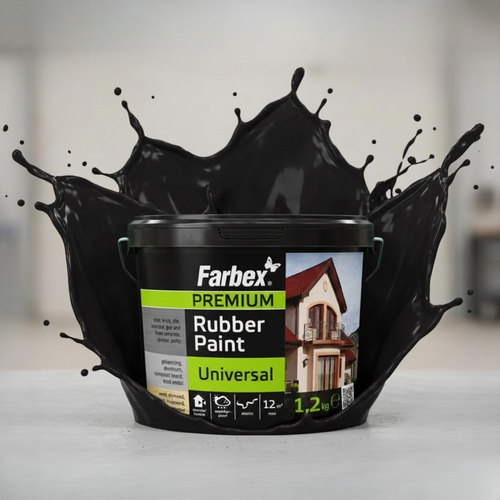
Liquid rubber paint for flat roofs — 14 RAL colours, 1.2 / 3.5 / 6 kg →

Second coat — armour
lightbulb
Pro tip

On heavily weathered bituminous sheeting apply a deep primer first. At frequently walked maintenance paths or chimney connections we recommend a third coat. Fleece reinforcement at connections is a processing recommendation from RubberPaint and not part of the manufacturer specification.

04 / Specifications

Technical data — liquid rubber flat roof coating

Consumption per coat 100–200 g/m² (0.1–0.2 kg/m²)
Recommended coats 2 (3 for heavily-stressed surfaces)
Drying time 2 h dust-dry · 4 h recoatable
Rain resistance after 6 h (manufacturer specification)
Full cure 28 days
Application temperature +10 °C to +30 °C
Service temperature −20 °C to +50 °C
Elasticity highly elastic (Class A0/C0 to EN 1062-1)
Use case Protective coating — not a primary waterproofing system
Binder Acrylic latex (solvent-free)
Tool cleaning Water, immediately after application
Material calculator

How much material do I need?

Enter your area and desired number of coats — we recommend the optimum tub combination.

Standard: 2 coats. 3 for heavily exposed surfaces.

info

Consumption: 150 g/m² per coat. +10 % buffer for offcuts and uneven surfaces. For larger projects (> 80 m²) contact us for individual advice.

Recommendation

6,6 kg needed

Calculating…

Total quantity
Total price

Free shipping from £170 — review your basket after adding.

06 / Bestsellers

Recommended liquid rubber paint colours for flat roofs

Black (RAL 9005) and graphite (RAL 7024) are the most popular choices for flat roofs — UV-stable and unobtrusive. White (RAL 9003) and light grey reflect heat on roofs above living rooms. Brown and red tones work well with traditional tile and slate.
Flat Roof Waterproofing — Liquid Rubber Coating & Sealant Guide

Liquid rubber flat roof sealant gives you a seamless, elastic waterproof membrane over old bitumen felt, EPDM, concrete, fibreglass or OSB — applied cold with brush, roller or airless spray. Two coats at 100–200 g/m² build a rubber film that bridges hairline cracks, follows thermal movement and resists ponding water on shallow falls. No torch, no specialist gear, no strip-out of the old roof.

Shop: Liquid rubber paint for flat roofs — 14 RAL colours, 1.2 / 3.5 / 6 kg tubs →

Can you use rubber paint to waterproof a roof?

Yes. Liquid rubber paint is a one-component, water-based acrylic-latex coating that cures into a continuous rubber membrane. Applied in two coats it forms a joint-free waterproof layer that stretches and recovers as the roof heats up and cools down — exactly where rigid paints and brittle old felt fail. It is the same product whether you call it rubber paint, liquid rubber, flat roof sealant or liquid roof coating; the only difference is how thick you apply it and how you treat seams and details.

On a flat roof it does three jobs at once: it seals existing leaks and cracks, it coats the whole surface against UV and weathering, and it adds a waterproof membrane without removing the old roof.

Coating, sealant or membrane — which does your roof need?

  • Flat roof sealant / leak repair — one leaking seam, a crack around an outlet or a split in old felt. Local repair: clean, bridge the crack with reinforcing fleece and apply two coats of liquid rubber over the patch.
  • Flat roof coating / sealer — the roof is sound but tired: chalking felt, faded EPDM, hairline crazing on GRP. Two full coats renew the surface and stop water getting into the substrate.
  • Liquid waterproofing membrane — a full overlay on a roof that has reached the end of its life: fleece-reinforced seams and upstands, then two or three coats over the whole area. The result is a new seamless membrane bonded to the old roof — no strip-out, no skip, no torch.

Which flat roofs can be coated with liquid rubber?

  • Bitumen felt — the most common UK flat roof. Liquid rubber bonds directly to bitumen once the surface is clean and dry; heavily weathered felt gets a bitumen primer first.
  • EPDM rubber roofing — bonds where ordinary paint peels. See Can you paint EPDM rubber roofing?
  • Concrete flat roofs and decks — fills the pores and bridges shrinkage cracks; allow for higher consumption on rough concrete.
  • Fibreglass (GRP) — lightly abrade the gelcoat first.
  • OSB, plywood and timber decks — sheds, garden rooms and garage roofs; boards must be dry and firmly fixed.
  • Metal sheet roofs — steel, galvanised and aluminium; remove loose rust and grease first.
  • Asbestos-cement — encapsulation only; never sand or cut the sheets.

How to waterproof a flat roof with liquid rubber — step by step

  1. Clean. Sweep, then wash with water and a little detergent, or pressure-wash on low pressure. Remove moss, algae, loose chippings and any flaking coating. Let the roof dry completely.
  2. Repair. Re-stick lifting felt laps and fill open splits. Bridge every seam, crack, upstand and outlet with a strip of reinforcing fleece bedded into a first coat of liquid rubber.
  3. First coat. Stir the tub, thin the first coat with up to 5 % water and apply with roller or brush at 100–200 g/m² depending on the substrate. Work the coating into the surface rather than laying it on thick. Rain-resistant after 6 hours.
  4. Second coat. After at least 4 hours at 23 °C (longer in cool or humid weather), apply the second coat at right angles to the first for full cover. Rough or absorbent surfaces may need a third coat.
  5. Cure. Rain-resistant after 6 h, walkable with care after 24 h, fully cured after 28 days. Tools rinse off with water.

Detailed walk-throughs: Seal a flat roof with liquid rubber and How to rubberise a flat roof.

How much liquid rubber do you need? Consumption and cost per m²

SubstratePer coatTwo coats
Bitumen felt (torch-on or pour-and-roll)120 g/m²0.24 kg/m²
EPDM, GRP, metal sheet (smooth, non-absorbent)100–120 g/m²0.20–0.24 kg/m²
Concrete (smooth)140 g/m²0.28 kg/m²
Concrete (rough)170 g/m²0.34 kg/m²
OSB / plywood / timber deck180 g/m²0.36 kg/m²

Example: a 20 m² felt garage roof needs about 5 kg for two coats — one 6 kg tub, with some left over for seams and fleece. Material cost works out at roughly £3.50–£4.50 per m², against £7–£13/m² for new felt or EPDM. Tub sizes: 1.2 kg, 3.5 kg and 6 kg. More detail: How many coats of liquid rubber do I need? and How much does liquid rubber cost per m²?

Liquid rubber vs bitumen roof sealer

Bitumen paint and bitumen roof sealers are cheap and familiar, but they soften in summer, go brittle in winter and need reapplying every few years. Liquid rubber cures to a UV-resistant elastic film that keeps its flexibility through frost and heat, comes in 14 RAL colours instead of black only, and can be recoated years later without stripping. It also goes straight over old bitumen, so switching systems does not mean starting from a bare deck. Full comparison: Liquid rubber — application, consumption & comparison.

Flat roof leak repair — patch or recoat?

If the leak is at one seam or one crack and the rest of the roof is sound, a local repair with fleece and two coats of liquid rubber is enough — see Repairing flat roof cracks without a torch. If the felt is chalking or cracking in several places, or you cannot find the leak, recoat the whole roof: a full membrane costs less than a second call-out and removes the guesswork.

Which colour for a flat roof?

Light colours such as white (RAL 9003) or light grey reflect heat and keep the room below cooler in summer; black (RAL 9005) and graphite (RAL 7024) hide dirt on roofs that are overlooked from above. All 14 colours are the same coating — choose a colour →

Flat roof waterproofing — FAQ

Can I apply liquid rubber over an old felt roof?

Yes — this is its most common use in the UK. The felt must be clean, dry and firmly bonded; re-stick any lifting laps first and reinforce the seams with fleece.

How long does a liquid rubber flat roof coating last?

Applied correctly in two coats it gives long-term protection; UV stability and freeze-thaw resistance are test-confirmed. Inspect every 5–7 years and apply a refresh coat if micro-cracks appear — an afternoon's work, no stripping.

Does it need a primer?

Not on sound, clean felt, EPDM or metal. Heavily weathered bitumen and porous concrete should get a bitumen or deep primer about 12 h beforehand.

Can I walk on it?

With care after 24 h (soft shoes, no point loads), fully load-bearing after 28 days. It is not a wearing surface for a roof terrace in daily use — those need a protective top layer or tiles.

Does it work on a garage roof, shed roof or dormer?

Yes. Consumption and the steps are the same as for any flat or low-pitch roof.

What about ponding water?

The cured film resists standing water on shallow falls, but long-term ponding shortens the life of any roof covering. Clear the outlets and, where possible, improve the fall before coating.

08 / FAQ

Flat roof waterproofing FAQ — sealing, coating and leak repair

Can I apply liquid rubber over an old bitumen felt roof?
Yes, after thorough cleaning (pressure washer, remove loose particles) and a bitumen primer as bonding base. Pre-fill cracks > 3 mm with repair compound. Stabilise heavily weathered bituminous sheets with deep primer.
What fall does the roof need?
At least 1.5 % slope for water run-off. Puddles form on horizontal surfaces — the coating tolerates standing water but the look suffers over time. With standing puddles we recommend spot-renovation of the slope first.
What happens if it rains while it is drying?
The first coat needs 6 h rain-resistant drying at 23 °C / 50 % RH. Longer at lower temperatures. Cover with a tarpaulin before rain or reschedule work to a 24 h dry period — precipitation in the first hours softens the layer.
Is liquid rubber a flat roof sealant or a flat roof coating — and will it fix a leak?
Both. As a sealant it repairs a leaking seam, crack or outlet: bridge the spot with fleece and two coats of liquid rubber. As a coating it renews the whole roof — two full coats over chalking felt, faded EPDM or crazed GRP. If you cannot find the leak, recoat the whole roof rather than chase it.
How long will the coating last?
With correct application the system provides long-term protection. UV stability and freeze-thaw resistance have been confirmed in extensive testing. Maintenance: visual inspection every 5–7 years, refresh coat if micro-cracks appear.

Got a technical question?

Our technical team advises on complex applications, substrate analysis and film-thickness calculation.