Rubber Paint for Wood — Application, Consumption & Lifespan
Rubber paint for wood has replaced classic wood stains and acrylic paints outdoors in recent years. Unlike rigid coatings, it stays permanently elastic, follows the natural movement of the wood and doesn't flake — even after 8 to 12 years of weathering.
In this guide we show why rubber paint (also known as liquid rubber, rubberised paint or flexible coating) performs particularly well on wood, what preparation is needed and what consumption you can realistically expect.
What is rubber paint for wood?
Rubber paint is a water-based acrylic latex coating with high elongation (over 300 %). It dries to a thin, closed rubber layer that protects the wood from moisture, UV radiation and temperature swings — and moves with the natural swelling and shrinking of the wood.
Compared with conventional wood finishes:
- Wood stain: soaks in and brings out the grain — but weathers within 3–5 years and has to be sanded off.
- Acrylic paint: forms a film, but a rigid one — prone to cracking at edges and knots.
- Rubber paint / liquid rubber: forms an elastic membrane, doesn't flake and can be recoated later without sanding.
Which types of wood does rubber paint work on?
Rubber paint adheres to almost all types of wood without a separate primer:
- Softwoods (spruce, pine, larch) — typical for fences and garden structures
- Hardwoods (oak, beech, ash) — furniture, decorative cladding
- Pressure-treated timber (tanalised pine) — the standard for outdoor structures
- OSB and plywood boards — e.g. roof boarding, the outside walls of garden sheds
- Old, greyed wood — like new after pre-treatment with a wood reviver
On very resinous woods (freshly felled pine, spruce with resin bleeding) we recommend a test coat in an inconspicuous spot. In rare cases resin can bleed through thin coats.
Uses: where rubber paint on wood really shines
1. Wooden fences
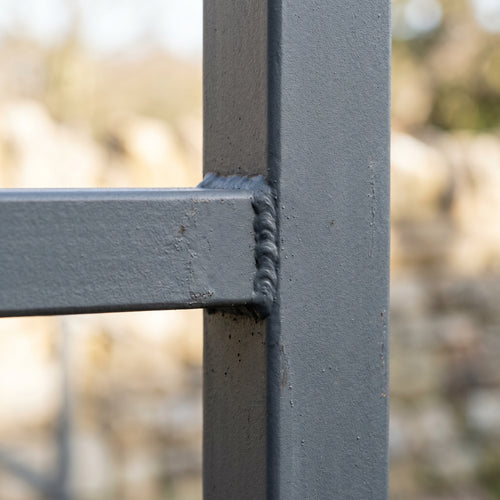
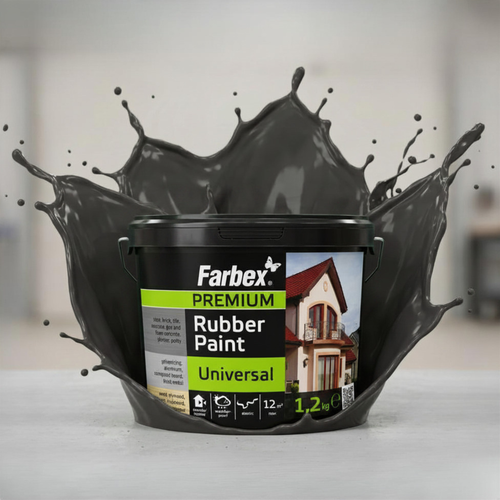
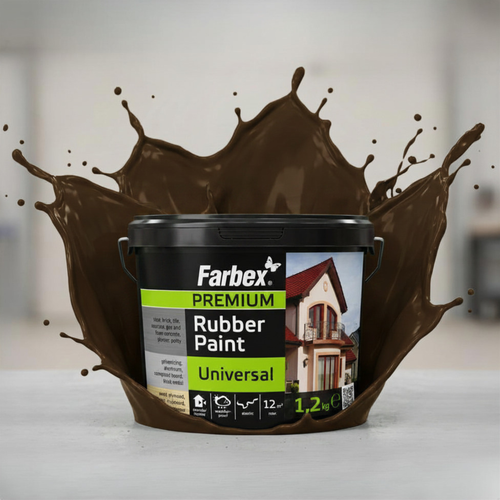
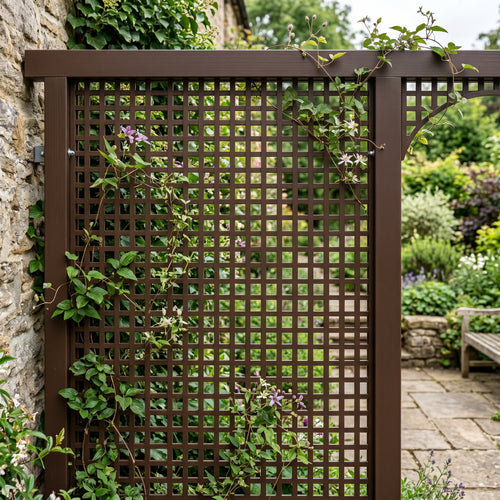
The classic. A well-prepared wooden fence painted with rubber paint needs no repainting for 8–12 years — and even then, a simple overcoat without sanding is enough. Recommended colours: Graphite (anthracite, RAL 7024), Brown (RAL 8017), Black (RAL 9005).
2. Pergolas and carports
Load-bearing timber structures benefit especially, because they expand with temperature and moisture. The elastic layer doesn't crack at the joints.
3. Garden sheds and outbuildings
Here UV resistance is crucial. Rubber paint achieves class A0 to EN 1062-7 (the highest UV resistance) and doesn't turn grey.
4. Timber facades and cladding
Breathable (sd value < 0.3 m) — water vapour escapes from inside, while driving rain is kept out. Ideal for timber-clad houses.
5. Wooden windows and door frames
The high elongation compensates for the movement of the wood at profiles and rebates. No cracking as with lacquers.
Preparing the wood surface
As with any paint job, most of the work lies in the preparation. Three steps:
- Clean. Remove algae, moss, dust and loose paint. Pressure washer at max. 120 bar, ideally with a wood cleaner. For greyed wood: apply a wood reviver (containing oxalic acid), then rinse thoroughly and leave to dry for 48 hours.
- Sand. Sand loose fibres and old coatings with 80–120 grit. On previously painted wood, keying the surface is usually enough.
- Fill cracks. Close cracks over 3 mm beforehand with wood filler or elastic sealant. Also treat knots with a shellac-based knotting solution so resin doesn't bleed through.
A primer is not necessary — on very absorbent wood, the first coat of rubber paint can be thinned with 5–10 % water and applied as a primer coat.
Application in two coats
Rubber paint can be applied with all the usual tools:
- Brush with natural bristles — ideal for corners, rebates and profiled boards
- Lambswool roller with 12–18 mm pile — for flat surfaces such as fence boards and cladding
- Airless sprayer 15–18 MPa, tip 0.017"–0.023" — for large areas and commercial projects
Consumption: approx. 100–200 g/m² per coat. Two coats are standard; on heavily exposed surfaces (tops of fences, the weather side) we recommend a third.
Drying times (at 23 °C / 50 % relative humidity):
- Touch-dry: 2 hours
- Recoatable: 4 hours
- Rain-resistant: 6 hours
- Fully cured: 28 days
Application temperature between +10 °C and +30 °C. Don't apply in direct sunlight or if rain is likely within the first 6 hours.
What rubber paint on wood can NOT do
Being realistic matters — rubber paint is no miracle cure:
- It's opaque, not a stain. If you want to see the wood grain, stick with classic wood stains.
- It doesn't replace structural wood preservation. Fungal attack and insect damage must be dealt with before painting.
- It can't handle permanent exposure to solvents (petrol, thinners) — not suitable as a coating for workshop floors in contact with solvents.
Costs: what does rubber paint cost for a typical project?
Example calculations at 0.3 kg/m² consumption for two coats:
- Garden fence 30 m × 1.8 m, both sides (108 m²) — approx. 32 kg of material, about 6 × 6 kg tubs
- Garden shed exterior walls (60 m²) — approx. 18 kg, about 3 × 6 kg tubs
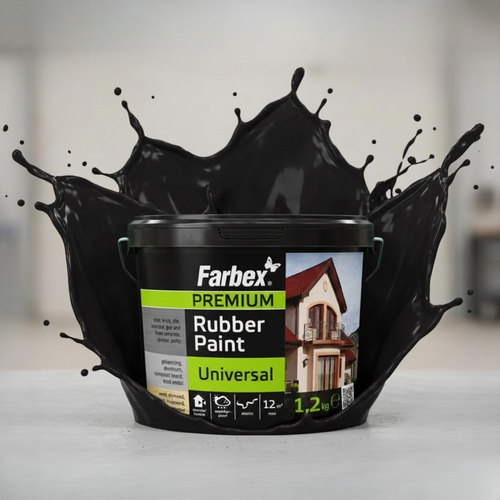
- Pergola (15 m² of visible surfaces) — approx. 4.5 kg, about 4 × 1.2 kg tubs
At a current price of around £7–9.50 per kg, rubber paint is often cheaper per m² than high-quality wood stains — especially once you factor in a service life of 8–12 years without any rework.
Frequently asked questions
Does rubber paint also hold on pressure-treated timber?
Yes — provided the timber has been left to weather and cure for at least 4–6 weeks after treatment. On freshly treated wood, preservatives can migrate to the surface and impair adhesion.
Can I paint over rubber paint later?
Yes — both with the same rubber paint (at any time) and with other water-based paints, as long as you sand first. Solvent-based lacquers on top are not recommended.
Is rubber paint food-safe for beehives or raised beds?
The cured coating is considered physiologically harmless (no solvents, no heavy metals). However, there is no official approval for direct food contact (e.g. the inside of a composter) — for that we recommend food-certified coatings.
How does rubber paint differ from bitumen paint?
Bitumen is rigid, dark and not UV-resistant. Rubber paint is elastic, available in many colours and fully UV-stable. For exterior wood, rubber paint is the better choice in practically every application. Detailed comparison: liquid rubber vs. bitumen →
Conclusion: when is rubber paint for wood worth it?
If you have an outdoor timber structure that you don't want to repaint every year, rubber paint is by far the most economical solution. Unlike stains or lacquers, the elastic layer follows the natural movement of the wood — it doesn't crack, doesn't flake and protects reliably for over a decade.
If you want to keep the natural look of the wood, however, you should stick with classic stains — rubber paint is an opaque coating.
Take a look at the available colours: all 14 rubber paint colours at a glance →
Related terms: Our product is sold in DIY stores and the trade under several names — liquid rubber, liquid rubber paint, liquid membrane, rubber paint, rubberised paint, flexible coating, elastic exterior paint or polymer coating. They all mean the same product: a waterproof, highly elastic coating based on acrylic latex.
RubberPaint Team
Technical editorial · RubberPaint