Painting a Wooden Fence — Fence Paint Guide

A wooden fence is the most demanding paint job in any garden: continuous UV, regular rain, and timber that swells in winter and shrinks in summer. Conventional wood stain or fence paint based on alkyd resins forms a rigid film that follows the timber for two or three seasons — and then cracks, flakes and peels. Liquid rubber fence paint solves the problem on a different physical principle: an elastic membrane that moves with the timber, indefinitely.
Why traditional fence paint never lasts long
Standard fence paints, wood stains and oil-based primers create a relatively brittle film roughly 60–120 µm thick. Untreated softwood like spruce, pine or larch changes its moisture content by up to 8 % through the seasons — the timber swells with autumn rain and shrinks again with summer heat. A rigid film can't handle that movement: tiny stress lines form, water gets in, the film lifts and the timber rots faster than before.
Within 2–3 years the same picture appears on every weathered fence: flaking around knots, peeling along the grain, grey patches where the film is gone entirely. The next round of paint costs the same as the first one — only this time it's on a now-aged substrate.
How liquid rubber solves the problem
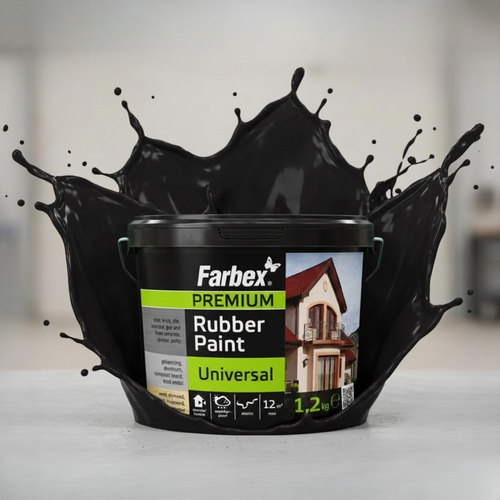
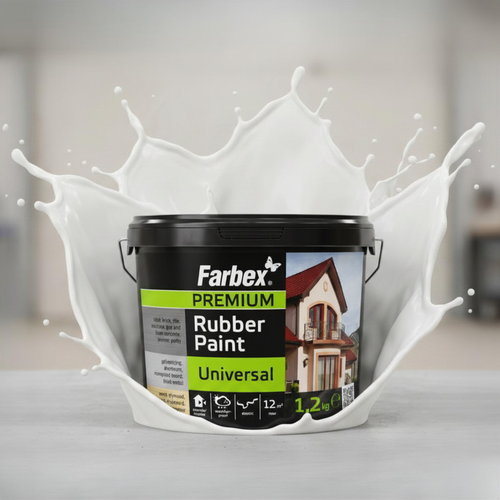
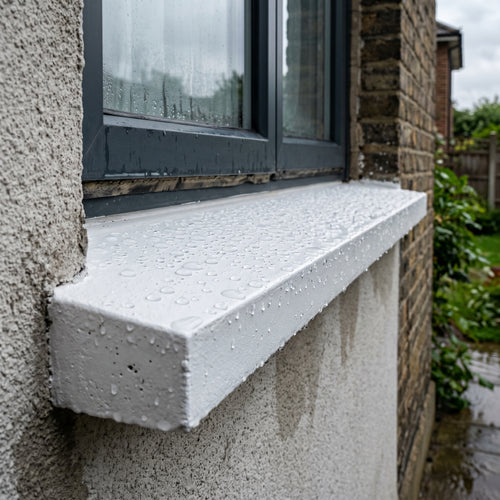
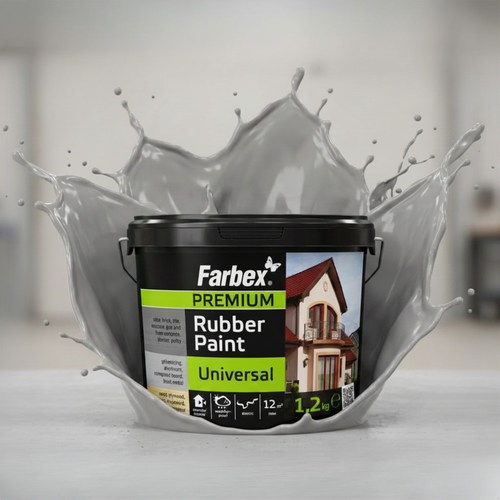
Liquid rubber (also called rubber paint, rubberised coating or flexible rubber paint) is a water-based elastic membrane, technically classed as crack-bridging. The cured film stretches with the timber's swell-and-shrink cycle and contracts again without losing adhesion — exactly the property that defeats rigid paints. Liquid rubber is solvent-free (no harsh fumes, water clean-up), bonds directly to bare or weathered timber, and is available in 14 RAL colours plus pure RAL custom tints on request.
Important: liquid rubber does not seal moisture inside the timber. The cured film is diffusion-open (V2 per EN 1062-1), so residual moisture from rain or condensation can escape outward through the coating without lifting it. That breathability is what lets the system last on timber where impermeable plastic coatings would trap moisture and accelerate rot.
Preparation: sand, clean, allow to dry
Good preparation is 70 % of a successful fence paint job. New timber needs less work than weathered timber, but neither can be skipped:
- Bare new timber: sand lightly with 120 grit to open the grain, dust off, allow at least 48 hours of dry weather before painting.
- Weathered grey timber: rinse with a stiff brush and detergent (or a wood-cleaner solution); remove silvered surface fibres with 80–100 grit; brush off dust; allow 3–5 days to dry depending on the season.
- Old painted fence: remove any flaking film mechanically (paint scraper, wire brush). Firmly adhering stain that doesn't lift can stay on — sand with 120 grit for a key.
- Pressure-treated timber: wait until any green or brown treatment has cured fully — at least 4 weeks after installation. Test for water absorption: a few drops on the surface should soak in rather than bead.
Moisture content of the timber at painting time should be below 18 %. In British conditions that means at least three consecutive dry days before you start.
Coat build-up on fence panels
Two full coats are standard for a fence; three coats on the weather side (south-facing in the UK) or on post bases where ground moisture is constant.
- First coat: thin with up to 5 % water to soak into the timber pores. Apply with a 50–75 mm brush in the grain direction. Pay extra attention to end-grain, knots and edges — these absorb most. Coverage about 180–220 g/m².
- Allow to dry for at least 4 hours at 18–22 °C, longer in cool damp conditions. The first coat will look matte and slightly absorbed into the wood.
- Second coat: undiluted, applied crosswise to the first (across the grain rather than along). Coverage about 150–180 g/m². Even visual coverage — the colour should look uniform, no thin patches.
- Optional third coat on south/west-facing weather sides or on post bases where ground moisture is constant. Apply 24 hours after the second coat.
Total consumption: 300–400 g/m² for two coats, or about 0.35 kg/m². A 6 kg tub covers roughly 17–20 m² of fence panel.
Maintenance after 5 years
Unlike traditional fence paint, the liquid rubber system doesn't need a full re-paint every 2–3 years. After 5 years on a south-facing weather side, you might see slight matting or a fine chalk layer in the most-exposed areas — never flaking or cracking. The fix is a single refresh coat: rinse off dust, allow to dry, brush on one more 150–180 g/m² coat. The new coat bonds to the existing film into a monolithic membrane.
On sheltered fence panels (north side, behind hedges, courtyard fences) the original two coats can last 8–10 years before refresh is needed.
Pro tip: when to paint a fence in the UK
Best window for fence painting in the British climate: late May to early September. You need:
- Three consecutive dry days for prep and drying
- Daytime air temperatures of 12–25 °C during application (above 30 °C the surface skins too fast and the second coat won't bond)
- No rain forecast for 24 hours after the final coat
Avoid painting in direct midday sun — work the shaded side of the fence first, then move round as the sun travels. Cool early mornings often have heavy dew on the timber until 9–10 am — wait for the moisture to evaporate.
Next steps
For a complete material calculation including the optimum tub combination for your fence length, use our Material calculator. For background on the technology and how it compares with other coatings, see the Wood coating landing page. Have project questions? Email info@rubber-paint.de — we usually reply within 24 hours.
RubberPaint EU Team
Technical editorial · RubberPaint