Best Paint for Rubber Outside — Wood, Concrete, Metal & Rubber

If you're looking for the best paint for rubber outside — protecting outdoor surfaces with a rubber-based coating, or covering existing rubber surfaces with a durable, weather-resistant paint — this guide covers the full picture.
We've tested rubber-based liquid coatings on every common outdoor substrate (wood, concrete, metal, masonry, existing rubber) and documented what works, what doesn't, and how to get 10+ years of protection from a single application.
Two meanings of "paint for rubber"
The search "paint for rubber" or "rubber paint for wood" often means one of two things:
- Meaning A: A paint that is itself rubber-based — applied to wood, concrete, or metal to create a flexible, waterproof rubber coating
- Meaning B: A paint that adheres to existing rubber surfaces — EPDM, PVC, weather seals
The good news: liquid rubber paint serves both purposes. It bonds to wood, concrete, metal, and masonry as a protective rubber coating; and it also adheres to existing rubber substrates better than any other paint.
Why rubber-based paint excels outdoors
Outdoor applications challenge every coating: UV strips bindings, water finds every gap, thermal cycling cracks rigid films, freeze-thaw splits porous surfaces, and biological growth attacks organic matter.
A rubber-based coating addresses these mechanisms simultaneously:
- Elongation 300%+ — accommodates thermal and substrate movement without cracking
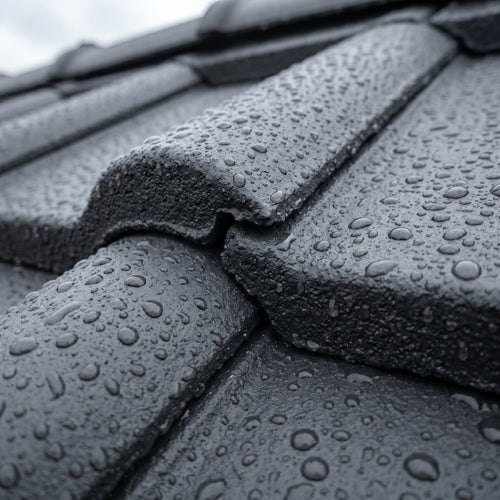
- Class W3 waterproofing — water cannot penetrate the membrane
- Class A0 UV resistance — no chalking or fading after 5+ years
- sd < 0.3 m breathability — water vapour can escape from inside (no blistering)
- Direct over rust — no separate primer required on metal
Best outdoor applications
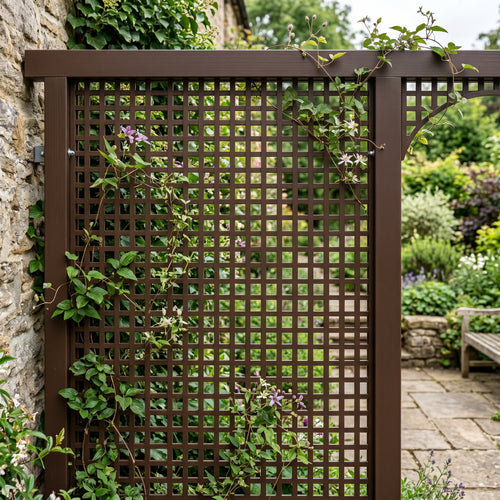
Outdoor wood (fences, pergolas, garden houses)
Liquid rubber paint outlasts every type of wood stain or varnish — 8–12 years versus 3–5. Critically, it doesn't crack, peel, or flake; it stays bonded to the wood through every seasonal cycle. After 12 years, refresh with a single coat — no sanding required.
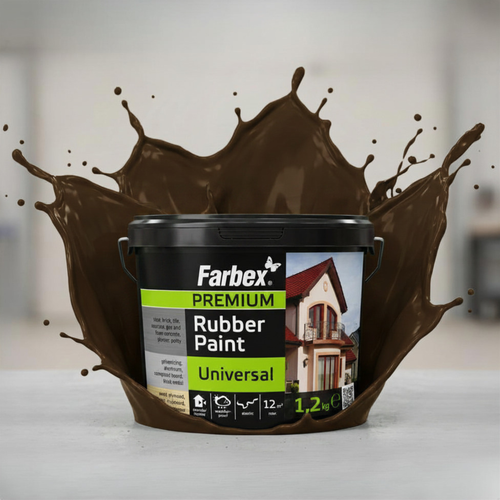
Best colours: anthracite (RAL 7024), brown (RAL 8017), forest green (RAL 6005), black (RAL 9004).
Concrete and masonry (walls, sockels, garden walls)
Provides UV protection, CO₂ barrier, and waterproofing all in one. Concrete carbonation (CO₂-driven degradation) is the leading cause of reinforced concrete failure; a rubber coating stops it cold.
Particularly valuable for: foundation walls, retaining walls, visible-concrete (Sichtbeton) facades, sockel zones at risk of frost-thaw spalling.
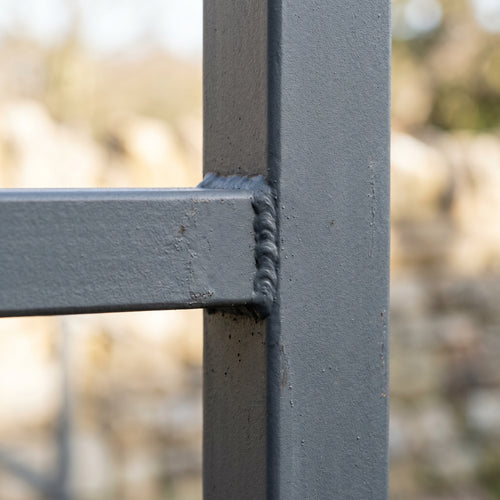
Metal (gates, fences, sheet steel)
Bonds directly to mild rust — no sandblasting required. Salt-spray resistant 1,000+ hours per ASTM B117. Use on garden gates, ornamental ironwork, sheet-metal carports, steel beams.
Existing EPDM roofing
Restores faded EPDM and adds 10+ years of UV protection. Particularly effective in white (RAL 9003) for Cool-Roof effect.
Flat roofs (bitumen, felt, concrete)
Best-in-class for residential and small-commercial flat roof renovation. Cold-applied, no torch required, single-pack water-based product.
Outdoor application: preparation by substrate
Wood
- Remove loose paint, lichen, and grey weathered fibre with a wire brush
- For very grey wood: apply wood brightener (oxalic acid) first, rinse thoroughly, let dry 48 hours
- Sand to 80–120 grit if previously coated
- Fill cracks > 3 mm with elastic wood filler
- No primer needed — first coat thinned 5–10% with water acts as the primer
Concrete and masonry
- Power-wash (max 120 bar) to remove dirt, salts, efflorescence
- Allow surface to dry 24+ hours (deep moisture OK; surface must be dry)
- Fill cracks with elastic crack filler
- For highly absorbent surfaces: first coat thinned 10% with water
Metal
- Remove loose rust and scale with wire brush — do not need bare metal
- Wipe oily areas with isopropyl alcohol
- Coat over residual surface rust (firm patina) directly — first coat acts as a rust-locker
Existing rubber (EPDM, PVC)
- Wash with detergent, rinse, dry 24 hours
- Solvent wipe with isopropyl alcohol
- Light abrasion with Scotch-Brite for older rubber
- Patch any seam failures separately first
Outdoor application steps (any substrate)
- First coat (thinned): 5–10% water for absorbent substrates (wood, concrete, masonry), 10–15% for low-energy surfaces (rubber, metal). Apply 150 g/m².
- Wait 4 hours at 23 °C / 50% RH; longer in cold or humid conditions.
- Second coat (undiluted): standard consistency, 150 g/m², cross-applied to first.
- Cure schedule: rain-resistant 6h, light use 24h, full cure 28 days.
Common colour choices outdoors
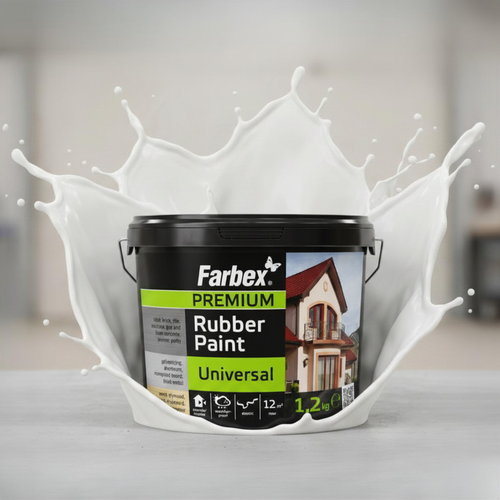
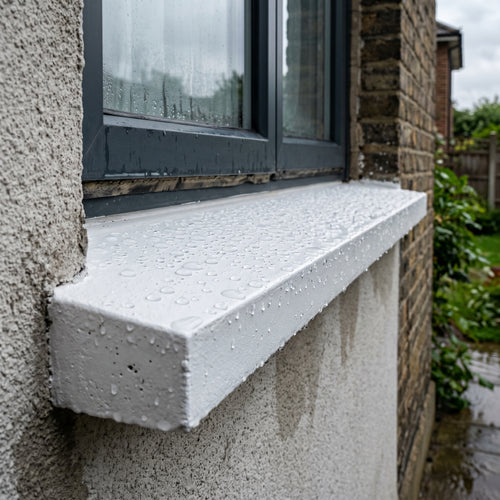
- White (RAL 9003): Cool-Roof, garden buildings, modern aesthetics. SRI ~95.
- Anthracite/Graphite (RAL 7024): Modern outdoor look. Pairs with anthracite windows.
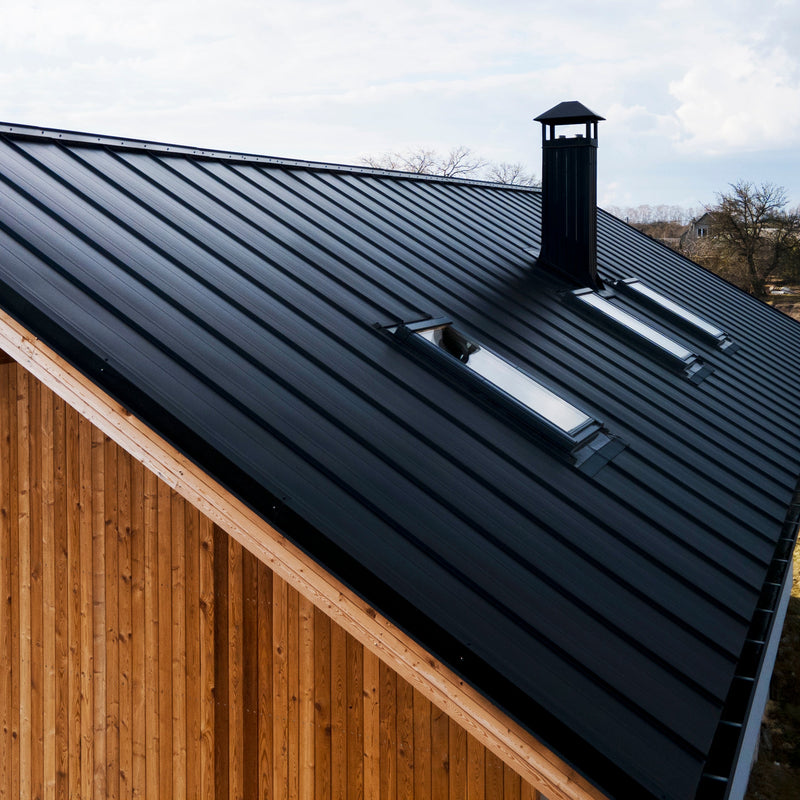
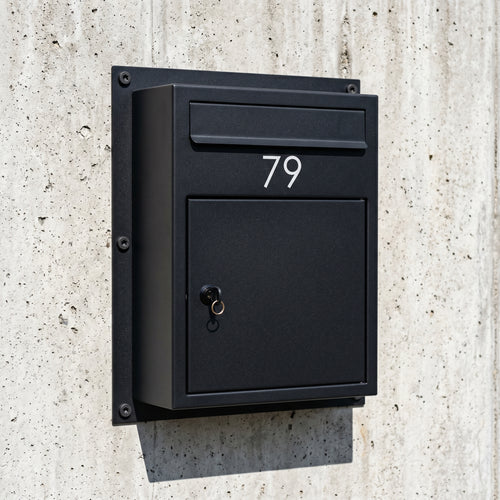
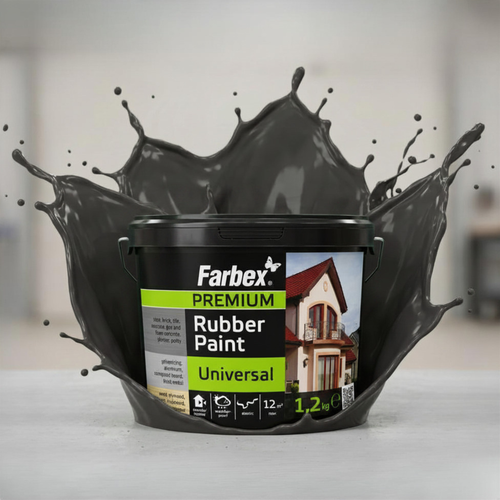
- Black (RAL 9004): Roofing, metal fences, dark statement walls.
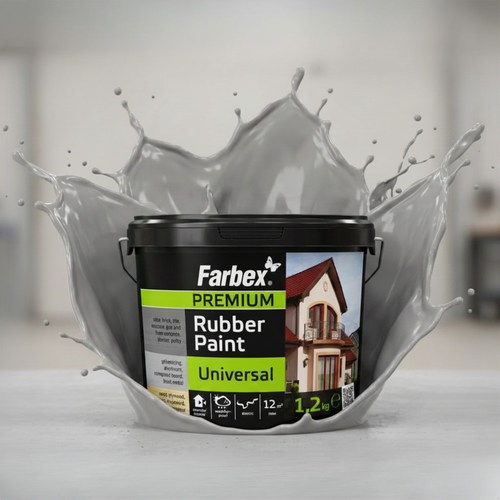
- Grey (RAL 7046): Versatile neutral.
- Forest green (RAL 6005): Garden integration.
- Red-brown (RAL 3009): Sockel zones, traditional aesthetic.
Cost comparison: rubber paint vs. alternatives outdoors
| Application | Rubber paint (10 yr) | Conventional alternative |
|---|---|---|
| Outdoor wood (€/m²/yr) | €0.50 | €1.80 (oil stain) |
| Outdoor metal (€/m²/yr) | €0.40 | €1.20 (rust paint) |
| Flat roof (€/m²/yr) | €0.30 | €8 (full EPDM replacement) |
| Concrete wall (€/m²/yr) | €0.40 | €1.20 (silicate paint) |
Conclusion
The best paint for rubber outside — whether you mean a rubber-based coating for outdoor protection, or a paint that adheres to existing rubber surfaces — is liquid rubber paint on acrylic-latex base. It outperforms classic stains, varnishes, rust paints, and silicate coatings on cost per year, lifespan, and substrate compatibility. One product covers wood, concrete, metal, masonry, and rubber — outdoors and indoors.
Browse the full range: Liquid rubber paint, 14 colours →
RubberPaint Team
Technical editorial · RubberPaint