How much does liquid rubber paint cost per m²? — Prices & worked example

Liquid rubber paint from RubberPaint costs between £3.50 and £6 per m² for the standard two-coat application at roughly 0.3 kg/m² total consumption. Larger tubs (6 kg) are significantly cheaper per kilogram than smaller ones (1.2 kg). On top of the material come modest costs for tools (brush, roller) and, on highly absorbent substrates, an optional thinner-bonded first coat.
How much does liquid rubber paint cost per m²? — Quick answer
The standard two-coat application consumes around 0.3 kg of liquid rubber per m² (2 × 150 g/m²). At our pricing of roughly £11.50–£19/kg depending on tub size, that works out to about £3.50 per m² in pure material for large tubs and up to £6/m² for very small quantities.
On top of material, plan for £0.30–£0.80/m² for tools (brush, microfibre roller), site cleaning and, on highly absorbent concrete, render or OSB, an optional thinned bond coat.
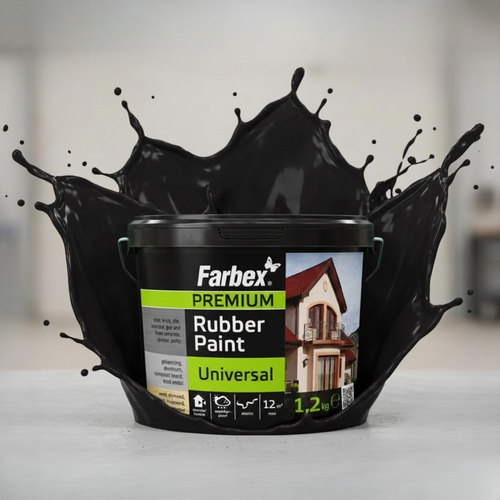
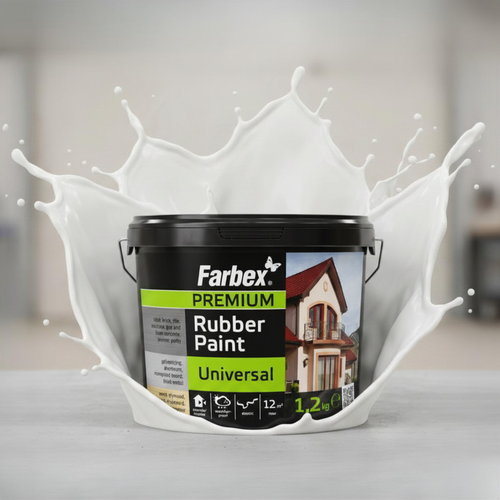
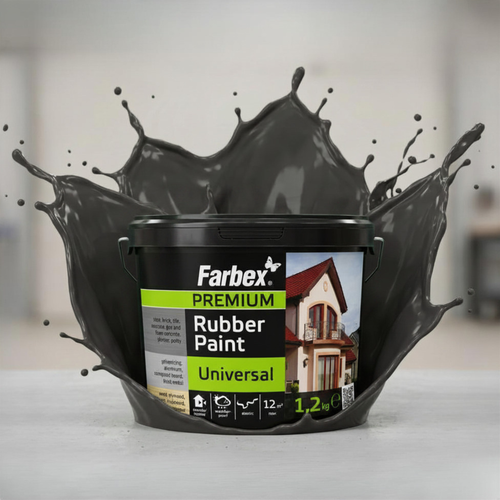
Tub prices — RubberPaint Universal
| Tub size | Price | £ per kg | Covers (2 coats) |
|---|---|---|---|
| 1.2 kg | £23 / €26.99 | £19.20 | ≈ 4 m² |
| 3.5 kg | £39 / €45.99 | £11.20 | ≈ 11 m² |
| 6 kg | £69 / €79.99 | £11.40 | ≈ 20 m² |
All prices include VAT. Updated regularly — check the shop for current figures.
Practical tip: for surfaces of 15 m² and above, the 6-kg tub is almost always the cheapest route — the per-kg price is around 40 % lower than the smallest tub.
Consumption by substrate — what really hits the m² budget
Real-world material consumption depends strongly on substrate absorbency and roughness. Smooth bitumen membranes use less; porous concrete or OSB boards use more.
| Substrate | Per coat | Total (2 coats) | £/m² (6 kg tub) |
|---|---|---|---|
| Bitumen felt (old, smooth) | 120 g/m² | 0.24 kg/m² | £2.75 |
| Concrete (smooth shutter face) | 140 g/m² | 0.28 kg/m² | £3.20 |
| Concrete (rough / exposed) | 170 g/m² | 0.34 kg/m² | £3.90 |
| OSB / plywood | 180 g/m² | 0.36 kg/m² | £4.10 |
| Render / brickwork | 160 g/m² | 0.32 kg/m² | £3.65 |
| Metal / corrugated iron | 130 g/m² | 0.26 kg/m² | £2.95 |
Worked example: 50 m² flat roof
For a typical 50 m² flat roof with a bituminous substrate the sums come out as follows:
- Material needed: 50 m² × 0.28 kg/m² (two coats on bitumen) = 14 kg
- Recommended tubs: 2 × 6 kg + 1 × 3.5 kg = 15.5 kg (10 % buffer included)
- Material cost: 2 × £69 + 1 × £39 = £177
- Tools: 1 × pro brush 75 mm (£6) + microfibre roller (£7) ≈ £13
- Total: approx. £190 or £3.80/m²
For an exact quote on your own job, use our Material calculator — it suggests the optimum tub combination for your surface and number of coats in seconds.
Liquid rubber paint vs alternatives — how does the cost compare?
At first glance, £3.50–£5/m² may not look cheap — but compared to other waterproofing systems the picture changes quickly:
| System | £/m² material | Application |
|---|---|---|
| RubberPaint liquid rubber | £3.50–£4.50 | Brush/roller, cold, DIY |
| Self-adhesive bitumen felt | £7–£13 | Torch-on, seam risk, fire hazard |
| EPDM single-ply membrane | £11–£18 | Adhesive bond, trade install |
| 2-component PU liquid system | £9–£16 | Mixing, pot life, hazardous |
On top of that: liquid rubber paint is DIY-friendly — you save the labour cost of a roofing contractor (typically £35–£55/m² inclusive on a small flat-roof job).
Hidden costs? What else you'll need
The raw material price is one thing — these line items should also feature in your project budget:
- Tools: brush or microfibre roller (≈ £8–£14). Wash-up with water, no white spirit needed.
- Substrate cleaning: jet washer hire if you don't own one (£20–£35 per day).
- Crack repair: filler for cracks > 3 mm (£5–£12).
- Bond coat (optional): only on highly absorbent concrete, render or OSB — a first coat thinned with up to 5 % water, no separate primer needed. Saves £1–£2/m².
- Masking: dust sheet and masking tape (≈ £5–£10).
Realistic total for a 50–100 m² DIY project: £4.50–£6/m² all-in.
Frequently asked questions about cost
Why are smaller tubs more expensive per kilogram?
Packaging, labelling, filling and logistics cost almost the same for a 1.2 kg tub as for a 6 kg tub. The per-kg surcharge on the small one covers those fixed costs. For any project of 10 m² or more, the 3.5 kg or 6 kg tubs almost always work out cheaper.
Do I need a primer — and what does it cost?
RubberPaint liquid rubber bonds without a separate primer in most cases. On highly absorbent substrates (porous concrete, OSB, aerated blockwork) a thinned bond coat (with up to 5 % water) serves the same purpose — no extra primer needed. Saves £1–£2/m².
Do you do volume discounts for large jobs?
Yes — for B2B orders from around 50 kg upwards we offer project-specific pricing. Enquire via the B2B form or email info@rubber-paint.de.
How much for a 20 m² balcony?
For 20 m² of concrete balcony you need 0.32 kg/m² × 20 = 6.4 kg + 10 % buffer ≈ 7 kg. Recommended: 1 × 6 kg + 1 × 1.2 kg = 7.2 kg → £69 + £23 ≈ £92 material, or roughly £4.60/m². Cold-applied, no torch needed.
Is shipping included?
Free shipping from £170/€199 order value across the EU and the UK. Below that, tiered shipping rates by zone apply (UK: £11 including customs handling).
Which RAL colours are available at the same price?
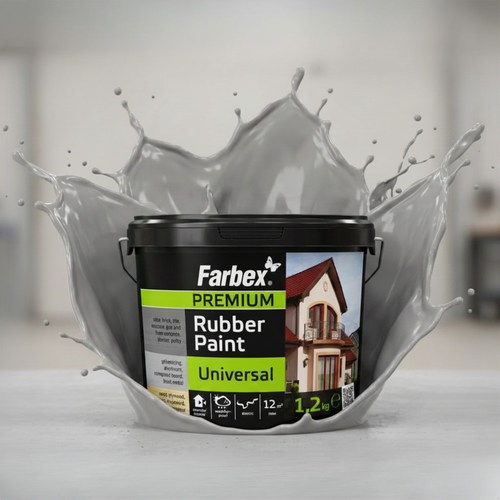
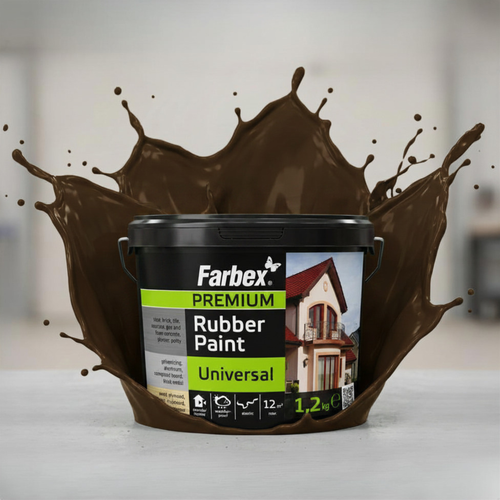
All 14 standard colours (Black RAL 9004, White, Grey, Anthracite, Brown, Beige, Green, Light Blue, Dark Blue, Yellow, Yellow-Brown, Light Green, Cherry Red, Red-Brown) at the same price. Custom RAL/NCS tints on request at a surcharge.
Bottom line — is liquid rubber paint a sensible investment?
For DIY projects of 10 m² and above, liquid rubber paint is in most applications the most cost-effective trade-grade option: £3.50–£4.50/m² for material, cold application, no specialist tools, no torch, no roofing contractor. On bigger jobs (30 m²+) the 6 kg tubs unleash their full per-kg saving.
Work out the exact material needed for your project with our Material calculator — it returns the optimum tub combination and total cost in seconds.
RubberPaint Redaktion
Technical editorial · RubberPaint